

activité de suivi pour mes élèves: outils, conseils, recaps, quelques blagues...
16 Mars 2020
HOW TO LIVE WITHOUT TECHNOLOGY?

"Tech-Less world" Book p 52
https://monespace-educ.fr/feuilleter/9782278074471
1/Brainstorm: what does it evoke for you? Note down your ideas and organise them in a mind map if possible to produce a poster
2/ Analyse this picture: say as much as you can, following the same old track: describe then, conclude. Pick as many details as you can: t's very fruitful!
Send your productions (written/ spoken)t can be done in pairs.


This assignment has been done by Damien G, TES

The document is a picture which takes place in Catskill in the state of New York. We can see a lot of trees in the background so the main colour is green and there are pebbles on the ground. So, The place seems to be wild have been chosen for its location in the country away from cities, out of town. But in the middle of the picture, there is a yurt: it is like a tiny house, it is green and brown with natural colours and materials such as wood. We can imagine that it is not very expensive, inside there is inside only necessary equipment to have a simple way of life. Moreover, Yet, the structure seems rather developed / cozy and comfy /comfortable as we can see a chimney, so we can think which leads us to think that it is a permanent housing. In front of his house, there's a middle-aged rather young man dressed in simple clothing. He's got a broom in his hands like as he's been cleaning and he looks as the owner of the place / he is standing in a proprietorial manner.
In conclusion, this man might have chosen to live simply in nature and away from technology and pollution. If so, it might have been because he couldn't stand it any longer / was fed up with his urban / former way of life
- maladroit: une photo ne se situe pas quelque part => l’endroit capturé / la photo a été prise à
=> The document is a photograph. It has been taken …. / It was taken in… (pas de date, donc on peut choisir l’aspect du bilan ici)
there is only necessary equipment => it is only equipped with the strict minimum
We can imagine=> we may assume
it is not very expensive=> tourner en phrase affirmative quand vous pouvez en anglais => it is cheap/ affordable
- inside there is inside => ordre des mots = ne jamais rien mettre entre VB et complément (pas comme en français)
- penser aux virgules après les mots de liaison
- Moreover, Yet, the structure seems rather developed => vous contredisez un peu ce qui précède: "rudimentaire" puis "développé"
donc marquer ce contraste avec "yet,"
chimney: le conduit extérieur (pas le "fireplace")
- middle-age = neither young nor old => il est plutôt jeune pas encore 30
- like he's cleaning and he owns the house. jamais "like " + s + VB => il faut "as" (sinon très familier = registre langue parlée familière
+ il a visiblement fini de balayé: il est arrêté, l'air un peu fatigué, et tout est propre: il faut present perfect + VB ING = has been cleaning (= on voit le résultat)
This assignment has been done by Clemence K, TES

This assignment has been done by Marie W, TES
mail exchange
It is just to give you an idea of the contents we are going to deal with. I think it may be fruitful to think of your outline (= plan) now even though you only have the notion, the question, and the first document. You may think of a plan already. Later, you may decide to alter it if you have better ideas thanks to further developments provided by the docs.
I hope everything is clear now


This assignment has been done by Max and Hugo, TES
CORRECTION 2/ Analyse this picture: say as much as you can, following the same old track: describe then, conclude. Pick as many details as you can: t's very fruitful!

a broom : un balai
be made of : être fait en /de
chimney: conduit de cheminée sur le toit
keep sth clean: garder qqch propre
a wood: un bois
be proud: être fier
experience : vivre
be fed up with: en avoir assez de
feel the full brunt of : sentir tout le poids de qqch
He might want to experience a different way of life
il se pourrait qu'il ait voulu expérimenter une autre façon de vivre
=> auxilaire modal MIGHT +BV = le locuteur exprime une hypothèse
QUESTIONS
ANSWER AND SEND YOUR GROUP'S ANSWER
• What do you think of this kind of living? Have you ever experienced such a way of life? What was it like?
→
• Would you accept to live such an experience?
→ Yes....
→ Definitely not. .....
• What forms of technology are most important to you?
→
ASSIGNMENT FOR THURSDAY: write a definition of your own on the notion "IDEA OF PROGRESS" then, compare it to the "official' one that I will publish then.
ON THURSDAY, YOU WILL have to study the video p 54 "Blackouts, when the light goes off" and stuff. there are 4 questions that you can work with a group of 2 or 3 friends.
https://monespace-educ.fr/feuilleter/9782278074471
If the video does not work follow this link 🎬
and there are some words to guide you at the bottom right-hand corner. If you have difficulty saying and understanding them, use a dictionary on line such as WordReference to look it up:
https://www.wordreference.com/enfr/look%20up
THE DIGTAL BOOK IS FREE OF ACCESS, which means YOU CAN view the video (click on the icon with the video at the top right-hand corner of the picture.
YET, if the video does not work follow this link 🎬
En français, pour jeudi tout le monde: étudier le document video p 54 "Blackouts, when the light goes off" et faire les questions. accès livre gratuit donc vidéo aussi (cliquer sur l'icône)
YET, if the video does not work follow this link 🎬
https://monespace-educ.fr/feuilleter/9782278074471
Vous pouvez travailler en chat/visio avec 2 ou 3 amis pour cette activité.
N'oubliez pas d'anticiper d'abord sur le contenu grâce au titre et à l'image (même si le bac CO est passé cette compétence est toujours d'actualité pour votre avenir... Il faut acquérir ce type d'automatisme. Le rendu, tapé, fichier nommé, à renvoyer par mail: yseult.fleytoux@gmail.com une fois le travail réalisé.
Si problème avec le lexique (banque de mots en bas à droite pour vous aider) utiliser WordReference en ligne, prononciation et traduction. Bien répéter les mots.
CORRECTION
Avec ce document nous touchons du doigt la réalité des menaces de coupures de courant et aux retombées possibles sur la vie quotidienne. Comment réagir quand ce qui nous semble aller de soi disparaît ?
La photo est extraite d’un reportage télévisé portant sur le blackout gigantesque survenu en Californie en septembre 2011 montre des personnes poussant leur caddie de supermarché alors que les néons sont éteints.
• C'est un reportage vidéo, un document authentique de la chaine Fox 26 relatant à chaud les conséquences de la coupure de courant qui a frappé San Diego le 8 septembre 2011 suite à une erreur de manipulation de l’un des employés.
Il alterne des faits objectifs et des témoignages personnels, il fallait faire attention à bien faire la différence entre, d’un côté, les faits objectifs et de l’autre, les sentiments exprimés par les témoins et classer les faits en deux catégories :
- les retombées de cette coupure de courant sur la vie au quotidien,
- les moyens mis en œuvre par les citoyens pour y faire face.
Proposition de relevé d'informations classées et de commentaires en synthèse:
video p 54 "Blackouts, when the light goes off"

• The blackout led to/provoked/caused much chaos and mayhem.
• People could easily find solutions and/or adapt to the situation.
• They made the most of the situation. They remained unruffled (imperturbable).. They felt they just had to grin (sourire) and bear it / to cope with it.
Intro: This is a news report about a massive power outage affecting California. Judging from the situation on the photo, we can guess it deals with the way people react to this electricity cut.
• A woman is talking to the camera. She might bethe news reporter...
• The scene takes place in San Diego, California.• A woman is being interviewed and she looks quite happy / she is smiling.
• We can see that everything is in the dark, that there is much traffic.
• The traffic signals are out/ineffective.
• There is one couple having dinner joyfully at a restaurant.
• They remain calm/unruffled (imperturbable).
• But people don’t seem to panic. It seems to be no big deal. They look quite enthusiastic.
Personal experiences of blackouts
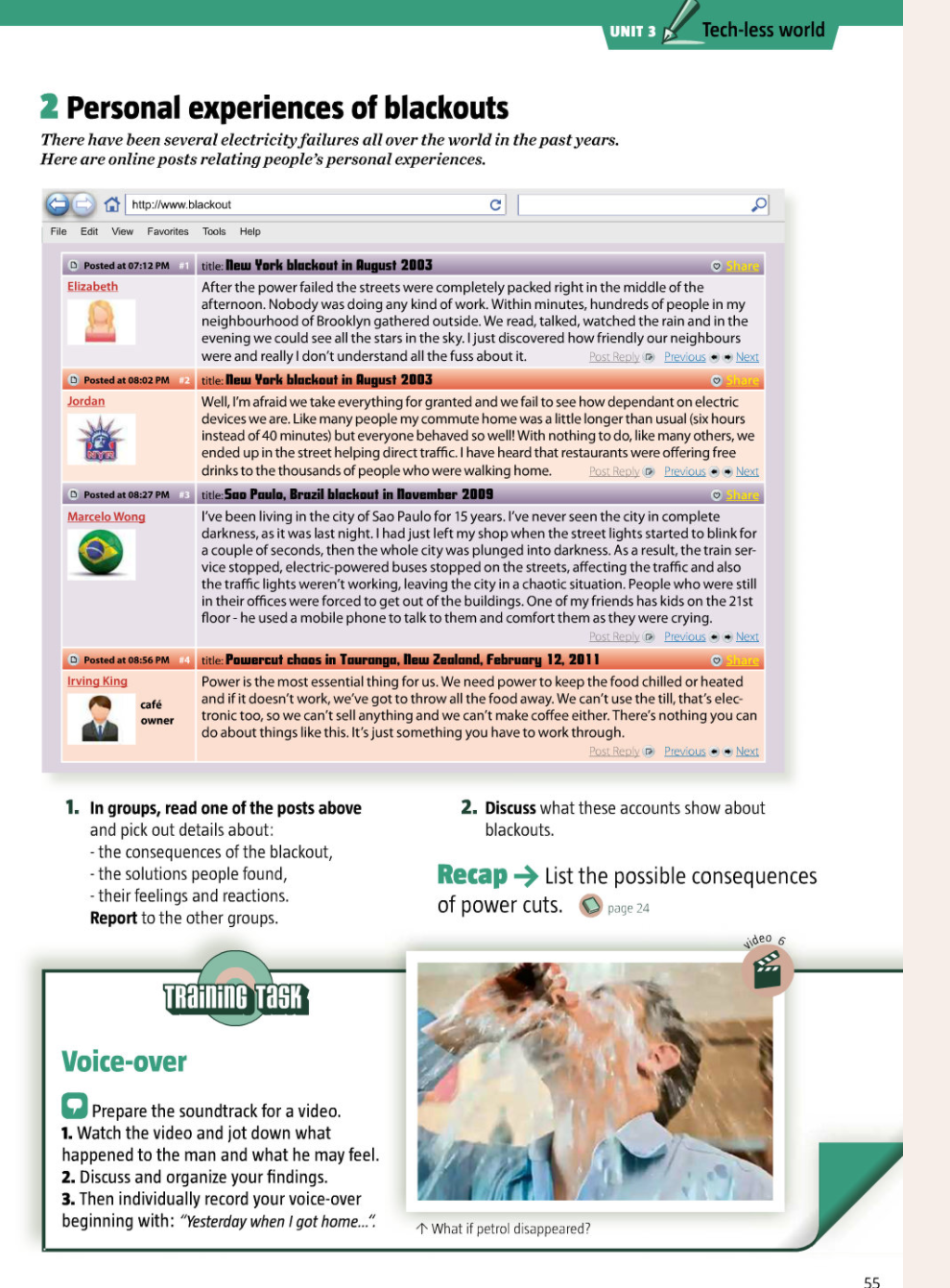
STUDY THE DOCUMENT AND ANSWER QUESTIONS 1 AND 2
THEN DO THE PART "RECAP" : List the possible consequences of power cuts
CORRECTION
Personal experiences of blackouts
Analyse du document
Une série de posts exprimant les réactions authentiques de personnes de différentes origines ayant vécu des coupures de courant de grande ampleur au cours de ces dernières années.
1. Details- consequences, feelings
• Jordan: New York, August 2003
Sincethere was much traffic jam, it took him much longer to get back home. People had nothing to do as a resultthey helpedthe police direct the traffic. Some restaurants even offered passers-by free drinks. Hence,the blackout favoured solidarity between people. Jordan considers this incident as an eye-opening incident, a wake-up call. Thanks to this kind of incidents, people realize how addicted to technology they have become without knowing it. Electric devices are taken for granted.
• Marcelo Wong: Brazil, November 2009 The city was plunged into darkness and there were nobuses nortrains anymore. This power failureled to chaos and mayhem. People were forced to leave the buildings. Some children were stuckon the 21st floor of a building, feeling panicky, and had to be comforted by their father who called them on the phone forthe elevator was ineffective. Marcelo finds this experience traumatizing and panicking.
• Irving King: New Zealand, February 2011
Without electricity which is vital/ essential for his profession, Irving couldn’t work normally. He had to throw food away and stop working. There was a lot of waste. The blackout led to many professional problems and losses.
2. Discuss
These accounts show that such incidents can happen anytime anywhere in the world. It causes many problems in people’s daily lives but, as a whole, people react positively.
3. Recap
Positive consequences:
• Lead people to gather and communicate.
• Oblige people to make the most of the situation...
Negative consequences:
• Create much havoc / havək/, disrupt, transport networks and business
• People can become disoriented
WORD BANK
since: depuis
even: même
Hence, ... d'où...
passers-by: les passants
traffic: circulation
were stuck: ont été coincés (stick, stuck, stuck)
electric devices: les appareils électriques
no/not ....nor: ni ... ni/non plus
power failure: panne de courant
mayhem: ravage, destruction, grabuge
taken for granted: pris/jugé pour acquis
feel panicky: se sentir paniqué
for = parce que (et pas = pour)
throw away: jeter
waste : gaspillage
as a whole: globalement/en général
Texte p 156 STUDENTS UNPLUG:

WORD BANKto better understand the text
experience (ed, ed, ing): vivre / expérimenter
not .... either : non plus
a fast : un jeûne
shorten (ed, ed, ing) (ed, ed, ing) : raccourcir
unplug : débrancher
devices= appareils
take part (in) participer (à) (take, took, taken)
varying (ied, ied, ying): variant
assignment : devoir/activité/tâche
keep + VBing: ne pas arrêter de faire qqch (le faire sans arrêt) (keep, kept, kept)
be hard not to + VB être dur de ne pas + VB
eye-opening : révélateur/trice
recover : s'en remettre
feel wanted: se sentir désiré (feel, felt, felt)
break the fast= rompre le jeûne (break, broke, broken)
even= même
slip (ped, ped, ping): déraper, glisser
behave(ed, ed, ing): se comporter
as though : comme si
boot up (ed, ed, ing): démarrer (métaphorique ici pour "se reconnecter")
assume (ed, ed, ing): supposer (ed, ed, ing)
most= la plupart(des étudiants ici)
vow to (ed, ed, ing): faire le voeu de
catch on : s'attraper, devenir contagieux,viral (catch, caught, caught)
consider, ed, ed, ing: envisager
you don't have to + VB = on est pas obligés de ... (texte...vivre au fond des bois...)
CORRECTION
STUDENTS UNPLUGGED (assignment done by Capucine L. )
______________________________________________
🔑This document may deal withthe description of an experiment carried outby 54 students in Portland’s Lincoln High school in 2010. This experiment consisted in stopping using technology
for a week. It may deal withthe way those students coped.
- Pour émettre des hypothèses: may+ BV
Rappel: experience: vivre/expérimenter une expérience: an experiment
______________________________________________
2) By reading the article, I understood that this assignment was proposed by an English teacher named Jordan Gutlerner who challenged his junior and senior students to unplug all their technological devices. This experiment = a new activity, idea or method that you try out to see what happens or whateffect it has
was based on the volunteering a voluntary basis and only two students took part at first. But three days later, his the 20 students who participated gave their impressions.
Amanda Shenberg said that she felt like as ifshe was missing important things; Robert Paige explained that when his parents weren’t home he used to turn on the TV and all the lights but with this assignment he had to do something else, which he did because he says that he sat and thought during this time. Paige who is also a videographer said it was hard for him not to check Craiglist, an online classified advertisement. Elise Cramer, as to her, said that, thanks to this assignment she saw/realised the importance people placedon feeling wanted. Each student learned/T something from their experiment, even if it didn’t last long because every single one of them cracked eventually broke the (technology)fast,; even the teacher ordered Chinese food with his cell phone (😆Well spotted).
(I have changed the word order:) At the end, Gutlernersaid / remarked that those devices were addictive even thought for people aren’t really who don't think they are addicted to them. When his students were allowed to boot up again, the English teacher confessed that he suspected most of his students (concordance des temps=>) will would return to normal usage but maybe some will would change their habits / some of them might change their ways.
At the very end, Elise Cramer concludes by saying that to be responsible, you don’t have to go live alone in the woods, away from everything and everyone, you just have to be conscious on how to use the technological devices.
🔑We don’t ask people to live as cavemen used to. The point is for people to become aware of what they are doing, the way they are behaving.
______________________________________________
3/ The experience itself: Jordan Gutlerner’s junior and senior students had to disconnect from every single one technological devices for a week or so.
The negative aspects of it: Students felt that they were missing something, important information through their mails or important news through facebook;they also felt disturbed, their habits being changed because of the experiment like Robert Paige who had to find other things to do besides instead of watching TV with all the lights on when his parents were away or to not not tobe able to refrain from checking Craigslist. They also experienced loneliness as Elise Cramer said/explained it, (because)without the social media, "no one can reach out to us"so they felt like as ifthey were alone whereas although they weren’t.
They also learned/t how, without knowing it, they were addicted to those as Gutlerner says
at the end of the experiment. = They also learnt/ discovered the extent of their addiction /// =They also learnt/ discovered how hooked they were.
=They also learnt/ became aware of their dependence (on their high-tech devices).
They learned that they were other sides to do to pass time than watching TV, chatting on Facebook, checking their e-mails…
refrain from = stop yourself from doing sth, especially sth that you want to do
4/ Elise Cramer’s conclusion underlines the fact that,you don’t need to isolate yourself from everyone and everything to be responsible. If you are well educated, you can use technological devices knowing the pros and the cons, and use them with awareness. If you know the bad sides of social media for example, you will use them wisely to avoid those some issues. If you know how much you can be addicted how addicted you are likely to become to technological devices,you will use them less than you used to be when you were not aware of that. To sum up, the best way to deal with technological devices is to be educated on those, so asto know/become aware abouttheir bad effects, to be aware of their harmful sidesimpacts so that, you, yourself, can make your and that will enable you to make yourown decisions to change the way you are using them/ behave wisely.
Recap: Explain why tech-free day experiments are a challenge.
I think tech-free day experimentScan be a challenge, especially to our generation.préferez " : " car vous expliquez votre idée
As It’s written reads in the text, we "were bornexposed to this society way too early"where they already had a huge place, so, as long as we can remember, we had technological devices to our service = we have been using technological devices. Knowing that, it is reallya challenge for us to try and disconnect them for a day, especially if you we are at home. Even if your parents are with you us,the families’ moments are everybody is usually around watching a good show or movie on TV at night or watch the news in the evening during dinner, or listening to music while you are gardeningwe are with them. Even our jobs include technological devices: exchanging e-mails, writing on a computer, watching videos, searching for some piecesof information on the Internet (ne pas séparer vb et objet)… We live using usethem every single day, and I think that’s why those experiences experiments are a real challenge/so challenging and exacting /demanding/ taxing.
CORRECTION
STUDENTS UNPLUGGED (assignment done by Juliette G. )
At the Lincoln high school in Portland, in October 2010. Elise Cramer and 53 other students participated in anexperienceEXPERIMENT launched by an English teacher, Jordan Gutlerner.
à formuler autrement : 1/ éviter la répétition 2/ ne pas calquer sur l'ordre des la phrase française:
They had to live without technology for a few days / a week and it was on a voluntary basis.
Utilisez le nouveau lexique du livre:
They had to unplug all their technological devices, including cell phones, computers, internet, video games and music-playing devices.
In this extract, we have 3 students who ARE talkING about their experienceFEELINGS. / SHARING THEIR FEELINGS AS THE EXPERIMENT IS UNFOLDING
And we can note many positive and negative aspects IN THEIR REPORTS.
First, some OF THEM can't help feeling lonely, or:
Elisa Cramer can’t check her mail FOR INSTANCE;
They don’t have any access to information.
Some are SO addicted THAT they JUST can’t continue the experienceEXPERIMENT. And after that, students willgo back to normal usage oftheirtechnology.
But there are positive aspects TOO. Firstly,these students are birthedwere born with technology; so here, they can discover a worldlife without technologyany.
Veillez à la concordance des temps:
For some, it’s kind of liberating. And contrary to someTHE STUDENTS who feel FELT lonely ISOLATED, someTHEY FOUND OUT THAT being aloneisWAS not such a bad thing,AS IT ALLOWED THEM TO they canthink of /PONDER THE experienceEXPERIMENT . Then, FOR THEM, it’sanIT WAS eye-opening experiment.
Mauvais emploi de virgules =vous "pensez français": cela devient ardu de comprendre
Mot de liaison inapproprié= je remarque avec plaisir que vous faites un effort réel pour articuler votre discours en les utilisant c'est très bien, et du coup c'est normal que vous les utilisiez parfois par erreur. Rassurez-vous, c'est normal et à force, cela va beaucoup s'améliorer.
For this reason, the teacher, the students must realize that they don’t have to live in the woods, but they must have conscious of the technology and the consequences. And it’s not the end for change our comportment.
proposition de correction=> As a result, the teacher and his students realized it was worth it to live a little differently and that they didn’t have to live in the woods to do so: they just needed to become aware of the technology and how they used it. It did not mean they had to end it all, just that they had to adjust their behaviours / adjust and make a few wise changes.
Therefore, that’s whyAs far as I'm concerned, Ithink we can’t live without technology (pas de virgule)because we are way too dependEnt. ici un point et reprendre ensuite:
It’s problemetic if we can't do without our technological devicesto give a call, do the cooking, get informed, exchange news or interact with others.
Yet, we can't change the way of the world, or can we?
(for calling, cooking, listen information, mails,… but we can decrease?? the time or change.)
Il est intéressant de noter qu'à l'heure actuelle où vous faites ce travail, les humains se comportent d'une façon qui était absolument impensable et inenvisageable il y a 3 semaines:
Actually, it is noteworthy to point out that just anything is possible and likely to happen:
just consider how the very idea of maintaining half the humanity home without using any means of private or public transportations and without consuming would have been preposterous only 3 weeks ago! Anyone who would have submitted such a scheme/proposition/idea would have been called nuts.
Correction STUDDENTS UNPLUGGED
1/ 🔑This document may deal withthe description of an experiment carried outby 54 students in Portland’s Lincoln High school in 2010. This experiment consisted in stopping using technology
for a week. It may deal withthe way those students coped.
- Pour émettre des hypothèses: may+ BV
Rappel: experience: vivre/expérimenter une expérience: an experiment
2/ Analyse de l'illustration

🔑We can see cavemen. One is juggling with sticks on fire. Two others are watching him regretting the time when fire didn’t exist. They wish fire hadn’t been invented because fire prevents them from communicating. This is a criticism of people who keep regretting things which belong to the past. Clearly, this is preposterous since thanks to fire, Man was able to improve his living conditions. So the point is not to go back to prehistoric times but to become aware of what we do.
since= puisque
The experience itself (1)
• 54 students involved among whom Elise Cramer
• unplug all technological devices for a week
• challenge was voluntary
• only two students refused to do it
• launched by English teacher Jordan Gutlerner
The negative aspects (2)
• some students were feeling anxious. They were afraid they might miss something important. Couldn’t take this off their mind • checking their e-mails was an obsession
• Cramer couldn’t resist the temptation and checked e-mails. It’s hard to go cold-turkey
• even the teacher slipped / was unable to go through
• many are addicts to technological devices
• people can’t do without them
• after the experiment, students will go back to normal usage. Won’t change anything in their behavior
Its positive sides (3)
• liberating to be unplugged
• a way to discover new things
• had to make efforts to shake off their habits and find new activities • some pondered over the role of technology in our world
• some found this experiment eye- opening even if it was tough
• people realized technology was not essential
• some students realized they were never left alone. They were connected all the time
• some will deactivate their Facebook account
• students will challenge other students later in the year
• a good lesson to be taught
Thanks to this kind of experiment, what we do is not a reflex any more but a free choice. From now on, these students will use Facebook of their own free
RECAP
This kind of experiment is a challenge because/ since:
• it plunges you in an unknown situation you will have to cope with,
• it forces you to dispense with what makes your life easier,
• your world unravels and you can lose your way/ become disorientated,
• it obliges you to make efforts to shake off some habits and find new activities,
• it forces you to question your habits,
• it makes you realize that what you take for granted may disappear. (may+ BV => hypothèse)

Dark times => Surviving B p 58-5

Dark times => Surviving B p 58-59
L’intérêt de ce texte est de poser la question du rôle du progrès technique : est-ce un rempart contre la loi du plus fort ? Ou un outil au service de la soif de pouvoir ?
1. ANTICIPATION
Aide lexicale:
Nouns: an axe (une hache)/ tyres : pneus/ streetlamps : réverbères / car wrecks : épaves de voitures / rifles= fusils / bows = arcs / wheat = blé/ peasants = paysans
Verbs :take place / meet / deal with / choose / be forced (to / upon)
Aide grammaticale=> utilisez les modaux pour émettre des hypothèses
We can see .... They might + BV .... It can’t + BV ... The text might deal with ....
2. COMPREHENSION /UNDERSTANDING
Read and explain what you have understood about a) the different characters and b) their situations
3. Spotting and picking / travail de repérage
a) The hamlet and its residents
b) The travellers
_________________________________________
En cas de difficulté, une aide est proposée dans le Workbook afin en mesure d’identifier les différents protagonistes REPONDRE ET CONSULTER LA CORRECTION SUR LE BLOG AVANT DE POURSUIVRE LA QUESTION 3/
• Use the context to identify who is speaking:
- Focus on lines 9-19. Identify who the following pronouns refer to:
he (l. 9) →
I, we (l. 14) →
he (l. 19) →
- Focus on lines 24-27. Identify who or what the following words refer to:
that (l. 27) →
his (l. 27) →
- Who is asking the question line 26?
- Focus on lines 27-30. Identify who “we” (l. 28 and 30) and “they” (l. 28 and 29)refer to.
→
→
Conclude: who are the two main protagonists?
→
What do they show about the two groups of people?
→
- Focus on each protagonist’s words: identify the main lexical field used:
food →
Conclude about these people’s main concern: →
_______________________________________________________________________________
4. Compare both groups of people
5. How do you understand the passage l. 28-30
"We ran into some survivalists, ... We're taking precautions to avoid another incident like that."
6. Describe what the world is like after "The Change
7. RECAP: Explain the impact of "the Change" on individual and social behaviour.
8. Training task : an encounter=> imagine and write the story of the encounter between Havel's group and the people from the campground down the river.
Aide lexicale
on the watch out/ defend. scared / fear / come across (rencontrer par hasard)
ready to fight tooth and nails / respect /wish / bury (enterrer) / let s.o. do thg ( laisser) / feed on (se nourrir de) / means of communication and transportation (moyens de communication et ...) / manage by oneself / manage on their own (se débrouiller /(tout seul)) / medieval weapons (armes médiévales) /
fend for oneself (se débrouiller tout seul pour se défendre/survivre/vivre etc.) / be likely to : être probable ...)/
shelter (abri) / feel safe / feel insecure / be full of / rifewith violence and aggressiveness
be deprived/stripped oforder and organization / tend to take the upper hand
Correction de la partie supplémentaires (questions guidées)
En cas de difficulté, une aide est proposée dans le Workbook afin en mesure d’identifier les différents protagonistes
• Use the context to identify who is speaking:
- Focus on lines 9-19. Identify who the following pronouns refer to:
he (l. 9) →Havel
I, we (l. 14) →the burly middle-aged man > the residents
he (l. 19) →the burly middle-aged man
- Focus on lines 24-27. Identify who or what the following words refer to:
that (l. 27) →the sentence that has just been uttered by the residents’ leader;
his (l. 27) →the burly middle-aged man
- Who is asking the question line 26?the burly middle-aged man
- Focus on lines 27-30. Identify who “we” (l. 28 and 30) and “they” (l. 28 and 29)refer to.
→the travellers
→the Survivalists
Conclude: who are the two main protagonists?
→The main protagonists are the two leaders or rather the leader of the residents and the group of travellers.
What do they show about the two groups of people?
→They are on the lookout / on the watch out: they are ready to defend their group against potential enemies. They both form a community eager to build cohesion.
- Focus on each protagonist’s words: identify the main lexical field used:
food →meat / elk / venison / bear / jerky / flour / rice or beans / eat
Conclude about these people’s main concern: →They are concerned with survival. They need to find food to survive.
Surviving
Analyse du document
Extrait du roman Dies the Fire de S.M Stirling dans lequel l’auteur décrit un monde post-apocalyptique où toute forme de technologie est absentesuite à une catastrophe dont on ignore la nature. Ce passage montre que la société moderne n’est plus: les hommes sont forcés de fuir les villes pour trouver de quoi se nourrir, tout est à reconstruire, certains choisissentle retour à l’animalité, la sauvagerie, tandis que d’autres tentent de rétablir un ordre social stable.
Bien qu’externeet à la troisième personne, cette narrationnous donne parfois accès aux pensées du héros, Havel. Le passage se situe au début du romanet nous expose la rencontrede deux groupes, le groupe errant du héro principal et le groupe d’habitants d’un hameau situé sur leur chemin.
L’intérêt de ce texte est de poser la question du rôle du progrès technique : est-ce un rempart contre la loi du plus fort ? Ouun outil au service de la soif de pouvoir ?
1/ Correction de la phase d'anticipation par rapport à l'illustration
• We cansee two groups facing. They might meetfor the first time.
• It can’t take placelong before the 20th or 21th centuries because we cansee car wrecks and streetlamps. This way of living is forced uponthem. They haven’t chosen it. There has been a kind of catastrophe. The text might deal withthe meeting of these two groups.
🔑 Vous voulez exprimer votre opinion sur le degré de probabilité ➠ les auxiliaires modaux:
They might meet...
It can’t take place...
The text might deal with
🔑Vous voulez exprimer l'idée que le sujet subit une action ➠ le passif (être + VB-EN)
is forced upon
2/(question 3 du livre) REPÉRAGES
The hamlet and its residents (réponses)
• Name= Lochsa
• State:Idaho
• Description:
- hard country for farming
- usually pleasant area fit forhobbies and fun but now the road is blockedby 6 people: residents
• The residents:heavily armed / armed to the teeth(hunting bows, axes, baseball bats)
• One leader:burly(=de forte carrure/solidement charpenté) / middle-aged = around 40 • Attitude:on the lookout = on the watchout = on the alert = standing sentinels/vigilantes
- aggressive - suspicious = diffident = (l. 20) →They protect their community and can’t allow too many people to stop over.
The hamlet and its residents (repérages par lignes/passages pour trouver les réponses)
• “Now half a dozen... baseball bats.” →l. 4-5
• “Afternoon,” the burly middle-aged man... already been through.” →l. 10-11 `
• “I’ve got to warn... enough for our own.” →l. 14-15
• “Several of the men stiffened with suspicion”. →l. 20
• “The little band of townsfolk relaxed. Their leader looked at the...” →l. 24
• “then? Looks like” →l. 26
• “That brought a few chuckles from his townsmen” →l. 27
• “The leader’s eyes took in their various bruises and contusions and spat eloquently.” →l. 31
• “What happened?” →l. 32
• “got another, louder chuckle”. →l. 34
• “A nod, and the leader leaned on his axe. We have a couple of horses...” →l. 37
The travellers ( réponses)
• Situation: -road people looking fora place where to settle.
- are heading towardsLewinston
- offers a deal / exchanges meat for rice and work
• Description: on horses (l.6) / carrying swordsand bows(l.25) (prononcer comme "go")
• 2 leaders:Havel (injured (=blessé) on his face because has fought with a bear) and Angelica
• Attitude:ready to fight (l. 30) = on the watchout→close-knit(= très uni/solidaire) group ready to defend themselves.
The travellers (repérages par lignes/passages pour trouver les réponses)
• “Havel reined in his horse ... of the rest behind him” →l. 6-7
• “...as a horse shifted in place. “Afternoon,” he said. ” →l. 8-9
• “Road people? Havel thought” →l.12
• “Havel nodded.” →l. 16
• “We’re fixed for now,” he said. “Got plenty of meat.” →l. 19
• “Already? Havel thought, ... or rice or beans.” →l. 20-23
• ... “swords the travelers all carried, and the bows.” →l. 25
• “You folks... together ...you’re loaded for bear!” →l. 26
• “Havel smiled thinly ...“We ran into some” →l. 27-28
• “We’re taking precautions to avoid another incident like that.” →l. 30
• “Havel shrugged.” →l. 33
• “Coyotes have to eat too, so we didn’t bury,” he said,” →l. 33
• “We’d like to camp for... we can do farrier work or such”. →l. 34-36
3/ (4/dans le livre) Comparaison entre les deux groupes
• We can see some similarities:
on the watch out; defending their people.
They are scared by the Survivalists and fear they might come acrossthem.
• They are ready to fight tooth and nails to defend their people but at the same time they respect strangers. `
Both groups wish they could build a stable society based on order and individuals.
4/ (5/ dans le livre) Expliquer le passage:
"We ran into some survivalists, origin-sovereign types. They seemed to think they could do anything they wanted, now that things are Changed? We're taking precautions to avoid another incident like that" (L. 28-30)
• Survivalists, original sovereign-type →a group of people ready to kill in order to survive and impose their leadership. • Original sovereign-type: perhaps they were ruling the country before the Change occurred and they still behave as if they were still the lea- ders in this “new” world. In this new world the question of survival is important as well as the question of leadership: society is not organized anymore = anarchy.
• Survivalists = do anything they can to survive / survive at all costs / favour / the strongest / defend “survival of the fittest” / take this as an opportunity to become rulers and leaders.
→Travellers are heavily armed the better to defend their community. →They have killed those men and didn’t bury their bodies to let the wild animals feed on them. →The Survivalists were ready to kill people to steal their food. They attacked Havel’s group but lost their fight as their bodies are left to coyotes...
Suite et fin de la Correction Dark times
5/ (6/ dans le livre) Décrire le monde après Le Changement
Cette question nécessite une prise de distance par rapport au texteet c'est le moment de réactiver le lexiqueintroduit sur les documents précédents (=> deprivation, dependence, obstacle,...)
• After the big Change, no means ofcommunication and transport = no more business / no more shops / no more news
• Everyone left to manage by themselves= no more rules / order = no more social organization = no more government = no laws
• No machinery = return to life without machines = cold / heat / food = problems = hunting
• No guns = return toancient / medieval weapons
• Only those who can find food (hunt animals) / defend themselves can survive
• People who cannotmanage on their own/ fend for themselves = likely to need protection from stronger people = “tribes”
→General fight for food, shelter(=abri); power
• The world is not safe anymore / people feel insecure. • It is full of /rife with violence and aggressiveness. It is deprived /stripped of order and organization.
• Barbarous people tend to take the upper hand and impose their illegitimate power.
RECAP => impact sur l'individu et ses relations avec les autres
• The big Change swept all the values away/ individuals are left facing their own conscience and personal ethics.
• Individuals are at a loss what to do, what to think.
• Some make the most ofthis extraordinary situation: to become leaders or to try to rule the world.
• Others are looking forcomfort and attempt to communicate and build some orderly society. • Human relationships are turned upside down.
• Security is annihilated. What matters is survival, basic survival instincts are revived/ become more important
REBUILDING A NEW LIFE B P60-61 (Lundi et jeudi 6 avril sur heure de groupe)

Anticipation 1/ look at the introduction and take a look at the photograph: place, characters, situation and try to guess what this is about
Rappel, pour faire des suppositions:
utiliser l'aux. modal"might" + "Base verbale"
exemple: How can he find food? →He might grow plants, corn, wheat...
• Place ? ........................................................................................................................................................
• The characters? ................................................................................................................................................
• Situation? ........................................................................................................................................................
• This excerpt might deal with ? ......................................................................................................................
(excerpt : extrait)
2/ Read and understand: sum up what you have understood in a few sentences.
Use the vocabulary below to better understand:
Lexique
corn stalks (l. 13) tiges de maïs
floods (l. 7) inondations
earth tremor (l. 8) secousse sismique
cobs (l. 13) épis
sewage (l. 18) eaux usées
windmill (l. 29) moulin
flush toilets (l. 22). des toilettes (avec une chasse d'eau ou autre)
excerpt : extrait
3/ Read the text again and list the following elements:
*DRAW CONCLUSIONS FOR EACH PART
*RECAP IN A SUMMARY
Lexique à utiliser
overcome vaincre
reach : atteindre
tamed: apprivoisé, domestiqué
manage to: réussir à
However + adj :
succeed in réussir à
get the upper hand : avoir le dessus
the bare necessities: le strict nécessaire
a land of plenty: une terre d'abondance
cosy and comfortable: douillet et confortable
recreate: recréer
endowed with : pourvu de, riche de, doté de
self-confident: sûr de soi
utter, ed, ed ing: prononcer
fiery : fougueux, impétueux, enflammé
tend (ed, ed, ing) to= avoir tendance à
inspired from: inspiré de
rewarding and merit: récompense et mérite
values: valeurs
ethics: éthique
teach somebody something : aprrendre à quelqqu'un / enseigner à qq
CORRECTION REBUILDING A NEW LIFE B P60-61
Anticipation 1/
• Place ? Honduras, Tropics. •
• The characters? Allie Fox (a brilliant inventor); his wife and children; natives. The narrator is one of his sons, Charlie.
• Situation? Theyhave just emigrated to start a fresh new life/start afresh/start from scratch/ break out of modern society.
• This excerpt might deal with the building up of this village. Description of its evolution. Success story.
2/ Read and understand: sum up what you have understood in a few sentences.
The novel entitled Mosquito Coast by Paul Theroux tells the story of a brilliant inventor called Alllie Fox, who decides to break out of modern society and start afresh elsewhere by creating a more harmonious community closer to nature and more humane
To do so, he has taken his family, that is his wife and his sons to live in Honduras right in the middle of the jungle.
In this extract, The narrator is Charlie Fox, one of his sons, and the scene is set in Jeronimo which is the village they have built up.
In the passage, the narrator describes and analyses the whole experiment: he starts with all the struggles against a hostile nature and show how rewarding that was as a result.
He especially focuses on his father's attitude who never stopped to rest after his success but on the contrary went on to develop it.
He clearly admires his father for his creative and powerful father who is clearly a source of great inspiration for him.
3/ Read the text again and list the following elements:
|
Positive aspects |
Negative aspects |
|
• We had defeated... • We had withstood...(résister) • We were organized... |
• the mosquitoes/ Mosquitia • the gardens |
|
• Purified water... plant (the only one in the world.) |
• June floods / September heat / Honduras weather • earth tremor • jungle |
|
Inventions |
Their consequences on people’s daily lives |
|
• an incubator for hatching eggs (l. 15) / a chicken-run |
• provide them with food • give them ice • permit them to get rid of wastewater • to make ice; like an engine • were able to travel to go from one place to another |
We can see that each obstacle has been overcome, they have reached a kind of balance,harmony: wild nature has become tamed: they have managed to organize chaos.
The pronoun “we” shows the success of a community.It’s a successful experience: however dangerous and hostilethis world might be, Allie Fox succeeded in making it his own.
We can see two semantic fields: control and hostility. They have access to more than the bare necessities. It has become a land of plenty: it isquite cosy and comfortable and it conveys an impression of abundance→the land was endowed with natural resources. They have recreated what was useful in their previous society...
It implies thateverything is done and the worst is behind them. Jeronimo has become “home”, they have “made themselves at home” in a hostile environment / they have managedto domesticate/tame nature. They have recreated a world adapted to their needs and wants.
They have turned this place into a new paradise/ an Eden-like home. It is a positive assessmentof the father’s wishes as Jeronimo is the father’sprize/reward
|
Quotations from the text |
|
The father’s statements • “So big, it only takes eleven of them to make a dozen” (l. 14) • “Control – that’s the proof of civilization. Anyone can do something once, but repeating it and maintaining it –that’s the true test” (l. 15-17) • “We’re clean!” (l. 18) • in a tank Father named the “Fish Farm”(l. 25) • “It could take a lifetime”, he said. ”But I’ve got a lifetime – I’m not going anywhere !”(l. 32) • “Hybrids ! Burpees! Wonder corn! Miracle beans! Sixty-day tomatoes!” ... (l. 33-34) |
|
Your conclusion • He is quite self-satisfied with his own making. Has a sense of humour. • He is quite self-confident. He utters what sounds like aphorisms as if he had understood it all from life. No doubts as to whether he is right or wrong. • There are many exclamation marks, which shows his wild temperament / he has fiery temperament / he is full of energy • He is quite creative. He tends to control everything by naming things. • He is determined, resolute but at the same time there's some dramatic irony. They are not going anywhere indeed. • Inspired from the Bible. Cynical? • The son is quite aware of the personality of the father who overblows things. /overdoes it.
|
|
The father’s attitude • “his names were always a bit grander than the things themselves.” (l. 25-26) • “Some of it he gave to people in return for work.” (l. 27) • “But he never handed out any food to beggars. What he preferred to do was to cut the produce open ....dry them.” (l. 28-31) • “River workers were rewarded with blocks of ice and bags of seeds. (l. 33) |
|
Your conclusion He believes in rewarding and merit. He has strict values and ethics that are based on work. He acts as the chief of Jeronimo. He feels superior and we are under the impression he teaches everyone a lesson. No charity but dignity. |
EXERCICES : LEXIQUE ET GRAMMAIRE

WORDS Book p 62.63
1. Feelings and attitudes
Exemple de production possible :
A young woman is leaning against a man who seems to be determined to protect her against the soldiers around them. Those ones are pointing rifles at them and look merciless and malevolent...
Or we could guess they are here to protect the couple... ( 100 mots environ)
Ce sera l’occasion d’utiliser :
angry - worried - prevent from – recoil - dislike – charitable - well-intentioned - compassionate – merciless - cold -hearted – invidious...
2. Cause and consequence
a. Cause : because - as – since - for - given that
Consequence : so - consequently - as a result - that’s why
b. 1. Since some kinds of technology are dangerous, people would like to get rid of them.
2. There was a massive power outage, as a result communities couldn’t work as usual.
3. People are accustomed to using technological devices, that’s why they don’t trust their personal capabilities anymore.
4. Because the blackout had spread all over the Bay of Plenty, Sheila’s earliest customers could not buy her famous cupcakes.
3. Talking about progress
|
Improvement |
Degeneration |
|
enrichment increase update
upgrade betterment progress |
downfall decrease crumbling deterioration regression worsening corruption |
GRAMMAR<=> CORRECTION
2. Since/for
Exemples possibles :
1. Ever since Man discovered fire, he has continuously discovered new techniques.
2. It must be years since you last saw your auntie!
3. For the past three months, they have been travel- ling all around the world.
Etc.
3. Present Perfect + since/for
Exemples possibles :
→Pupils have been taught with basic softwares for years but since the recent technological advances, they have rediscovered how to use a computer.
→Computers have greatly evolved since the last few years.
→Teachers have adopted new teaching methods since computers entered the classroom.
Etc.
4. Present Perfect + since/for
Exemples possibles :
I’ve had my i-phone for two weeks now! I just can’t live without it! I have already sent about a hundred text messages since I bought it...
5. a/the/Ø “Where’s the DVD I bought yesterday?”
“What DVD? I did not know you had bought a new DVD.”
“Well, yes I did. It’s the film we talked about last week with Peter and Clara”
“We talked about Ø.films all evening! Remember, you nearly had a fight because Clara thought Ø musicals were for Ø stupid people.”
“You know, the film about a family who builds a new town in Ø Central America out of nothing.”
“Oh, right. We would find it easily if you were not so messy. Look at the room. There are Ø DVDs, Ø books, Ø video games, Ø clothes and Ø old sandwiches everywhere.”
“That’s not an old sandwich, it’s a/the baguette I bought for tonight’s dinner.”
“Aaagh! Ø Brothers are a pain! »
6. a/the/Ø
Légende de l’iconographie, manuel p. 54.
Exemples productions possibles :
→The young women are serving pizzas and offering a glass of water to the customers who feel lost because of the blackout...
→American customers are rushing through the alleys of a store to try to find food and are happy to be able to drink a real coffee...
7. Exemples de productions possibles : →Since the storm damaged our area, we have been
obliged to sleep in a gymnasium and to eat cold food.
→We have stayed at our cousins’ for two weeks because there was no electricity in our area.
→We have not had any hot shower since the storm.Etc.
|
|
Article associé à... |
||
|
|
a |
the |
Ø |
|
Nom indéfini singulier |
X |
|
|
|
Nom défini singulier |
|
X |
|
|
Nom indéfini pluriel |
|
|
X |
|
Nom défini pluriel |
|
X |
|
|
Sens générique |
X |
X |
X |
|
Sens particulier |
X |
X |
|
8. Practise
a. In the jungle, you find Ø small houses but the house we built was nice and roomy. It was a house made of Ø bamboo and Ø liana.
b. Ø Food was hard to find and Ø meat was scarce, but the meat we ate was very tasty.
c. We adopted a wild dog that we called “Roofy” because we found him on the roof of a house. d. We often helped the local population. It was a fantastic experience, the experience of our lives!
g →Précis grammatical 4 p. 192
9. a. It was hard/difficult to find Ø water but the rivers were clean and the water they drank was not polluted.
b. Ø Cereals were scarce but the inhabitants often ate Ø fruit.
c. Allie was studying Ø flowers and Ø botany. The plants he found here were more coloured.
d. They had built a bridge to cross the river. The bridge was narrow but useful.
FORUM QUESTIONS-ANSWERS
SOLVED
When we are on the site of the online manual we don't understand how to access to the video : "Blackouts : when the lights go off, Breaking News" p54. Can you help us ?
Teacher = Strange. I can't figure out why it no longer works. I will try to contact the people in charge.
Évaluations CE et EE
Name :
Class :
UNIT 3 Tech-less world
Compréhension de l’écrit
Roy didn’t believe they’d still be here when it fi rst snowed, but he nodded as his father
climbed down in and then he took the pieces1 his father handed him and carried them
back to the cabin. Roy knew that somehow this disappointment was worse for his father
than the other disappointments had been. If Roy spoke now, he doubted he’d be heard.
And he understood this about his father, that he was often gone into his own thoughts
and couldn’t be reached, and that none of this time spent alone thinking was good for
him, that he always sank lower when he went in there.
They stacked the wood against a side wall, and when they were done, they looked again
at the pit2, at the mud deepen ing and the walls caving, and both looked into the sky,
into the grayness that had no depth or end, and then they went inside.
When the plane came a few days later, Roy was fi shing several miles up the coast. He
thought he heard it, then thought he must have made it up, but stopped and listened
and heard it again. He pulled in his line, grabbed the two salmon he had caught, and
started running. He was far enough off, though, and blocked by so many small points
along the way, that he couldn’t see it fl y into the mouth of their cove3. He ran over the
rocky beach and, when he had to, up into the trees and down again, becoming more
and more afraid that he would miss it. He assumed his father was there cutting wood,
but what if he had hiked back over the ridge for some reason and no one was there?
The pilot might not come back again for a long time, might just leave a note saying,
Call me on the radio if you need anything. And there was another thing, too, that Roy
didn’t like to admit. Even if his father was there, what would he say? Was there a chance
he would just say everything was fi ne and send the pilot away and not have him come
back? It didn’t seem impossible, and Roy needed to leave here, he needed to get away.
Roy dropped the fi sh and his pole and ran faster.
He was only a few hundred yards from the fi nal point when he heard the drone of it again
and stopped to see it rush out of the mouth, tilt free of its own spray, and lift pre cariously
over the channel. He stood there then, looking at where it had fi nally disappeared and
breathing hard and feel ing that something terrible had happened.
He left, he said out loud. I missed him.
He went back then for his pole and the salmon and walked on to the cabin.
His father was back at the woodpile. Tom came by, he said when Roy-walked up.
I heard.
Oh. Well he was just here a minute but I ordered the sup plies we need and he’ll be back
with them next week on his way to Juneau4. Though not really on his way exactly, I suppose.
And his father grinned then, pleased at how in the middle of nowhere they were.
Roy took his salmon down to the water and gutted them. He scaled them quickly and
cut off their heads and fi ns and tails. He wanted out of here. He didn’t care what his
father thought about it; he was just going to go.
You want to leave? his father asked when he told him at dinner.
Roy didn’t say it again but just ate. He felt terrible, as if he were killing his father.
We’re not doing so bad, are we? his father asked.
Roy refused to cave in5. He didn’t say anything.
I don’t understand, his father said. We’re fi nally getting somewhere. We’re getting
ready for winter.
Why? Roy thought to himself. Just so we can survive win ter? But he didn’t say anything.
Look, his father said. You’re gonna have to talk to me about this, otherwise you’re just
staying and that’s that.
Okay, Roy said.
Why do you have to go?
I want my friends again, and my real life. I don’t want to just try to survive winter.
Fair enough. But what about me? You told me you’d stay out here a year, and I made my
plans. I quit my job and bought this place. What am I supposed to do if you just leave?
1
Roy wanted to say right then that he’d stay, but he couldn’t. He knew terrible things
were going to happen to him out here if he stayed. He did the dishes and then they
went to bed.
David Vann, “Sukkwan Island” in Legend Of a Suicide, 2009
1. pieces of wood
2. cavity where they keep the wood dry
3. cove = little bay
4. capital of Alaska
5. cave in = agree /cooperate
1/ Read the text carefully, then answer the questions
Circle the right answer: 4 pts
a. This text is an extract from: an autobiography – a testimony – a diary – a novel – an essay
b. The best title for this extract is: city life – rescue work – a fi shing party – remote life
2/ Who are the characters actually present in the scene and the characters who
are simply mentioned? Give as many details as possible about each of them (name,
relationships, occupation) 4 pts
..........................................................................................................................................................
..........................................................................................................................................................
..........................................................................................................................................................
..........................................................................................................................................................
3/ Answer very briefly the following questions, then justify with a quotation from
the text. 10 pts
a. What time of the year is it?
..........................................................................................................................................................
..........................................................................................................................................................
b. Where do the characters present live? (country, housing, environment)
..........................................................................................................................................................
..........................................................................................................................................................
c. What is their way of life?
..........................................................................................................................................................
..........................................................................................................................................................
d. What is the main event in this passage? What happened on that day?
..........................................................................................................................................................
..........................................................................................................................................................
4/ Focus on Roy: say if the following statements are true or false. Justify by quoting
from the text. 12 pts
a. Roy doesn’t bother about what happened that day.
..........................................................................................................................................................
..........................................................................................................................................................
b. Roy is happy with his life
..........................................................................................................................................................
..........................................................................................................................................................
c. Roy has lived in this place for less than a year.
..........................................................................................................................................................
..........................................................................................................................................................
d. Roy understands that the early snow will make their life more diffi cult.
..........................................................................................................................................................
..........................................................................................................................................................
e. It is diffi cult for Roy to communicate with his father.
..........................................................................................................................................................
..........................................................................................................................................................
f. Roy is torn apart at the end of the passage
..........................................................................................................................................................
..........................................................................................................................................................
5/ Focus on the passage from line 33 “Roy took his salmon down to the water” to
the end.
Choose the adjectives that best characterize the two protagonists. Then justify, quoting
from the text. 10 pts
self-satisfi ed / selfi sh / compassionate / thrilled / obedient / optimistic / pessimistic / rebellious
/ guilty / authoritative
..........................................................................................................................................................
..........................................................................................................................................................
..........................................................................................................................................................
..........................................................................................................................................................
Expression écrite Choose one of these two subjects
1/ Two e-mails
You’ve just heard that one of your friends has decided to be away and out of touch for a year.
Send her/him an e-mail to convince her/him he must keep in touch wherever she/he is. Your
friend replies, explaining why she/he wants to be out of touch. Write both e-mails. (200 words)
2/ A conversation
An extensive network failure has left hundreds of mobile phone users unable to use their mobiles
for a whole day. Imagine a conversation between two users. One thinks it was a great day; the
other thinks it was a disruption that should never happen again.


/https%3A%2F%2Fassets.over-blog.com%2Ft%2Fcedistic%2Fcamera.png)
/http%3A%2F%2Fwww.breakingnewsenglish.com%2F2203%2F220321-smartphone-repairs1.jpg)
/https%3A%2F%2Fapi-cdn.arte.tv%2Fapi%2Fmami%2Fv1%2Fprogram%2Ffr%2F070794-000-A%2F1920x1080%3Fts%3D1617954944%26type%3DTEXT%26watermark%3Dtrue)
/image%2F0753475%2F20220303%2Fob_55e545_capture-d-e-cran-2022-03-03-a-23.png)